

Baghchal is a board game from Nepal. One player has four tigers. The other player has twenty goats. The tigers try to capture the goats. The goats try to trap the tigers.
The rules are easy. You can learn them in five minutes. Playing well takes much longer. This guide shows the rules, gives tips for both sides, and tells you what we know about where the game comes from.
We make Baghchal Online, a Baghchal app. We wrote this guide so anyone can learn the game.
Baghchal in 30 seconds
- Two players. One plays 4 tigers. The other plays 20 goats.
- The board has 25 points joined by lines.
- Goats move first. They add one goat to the board each turn.
- Tigers step along the lines, or jump over a goat to capture it.
- Tigers win when they capture 5 goats.
- Goats win when no tiger can move.
The board
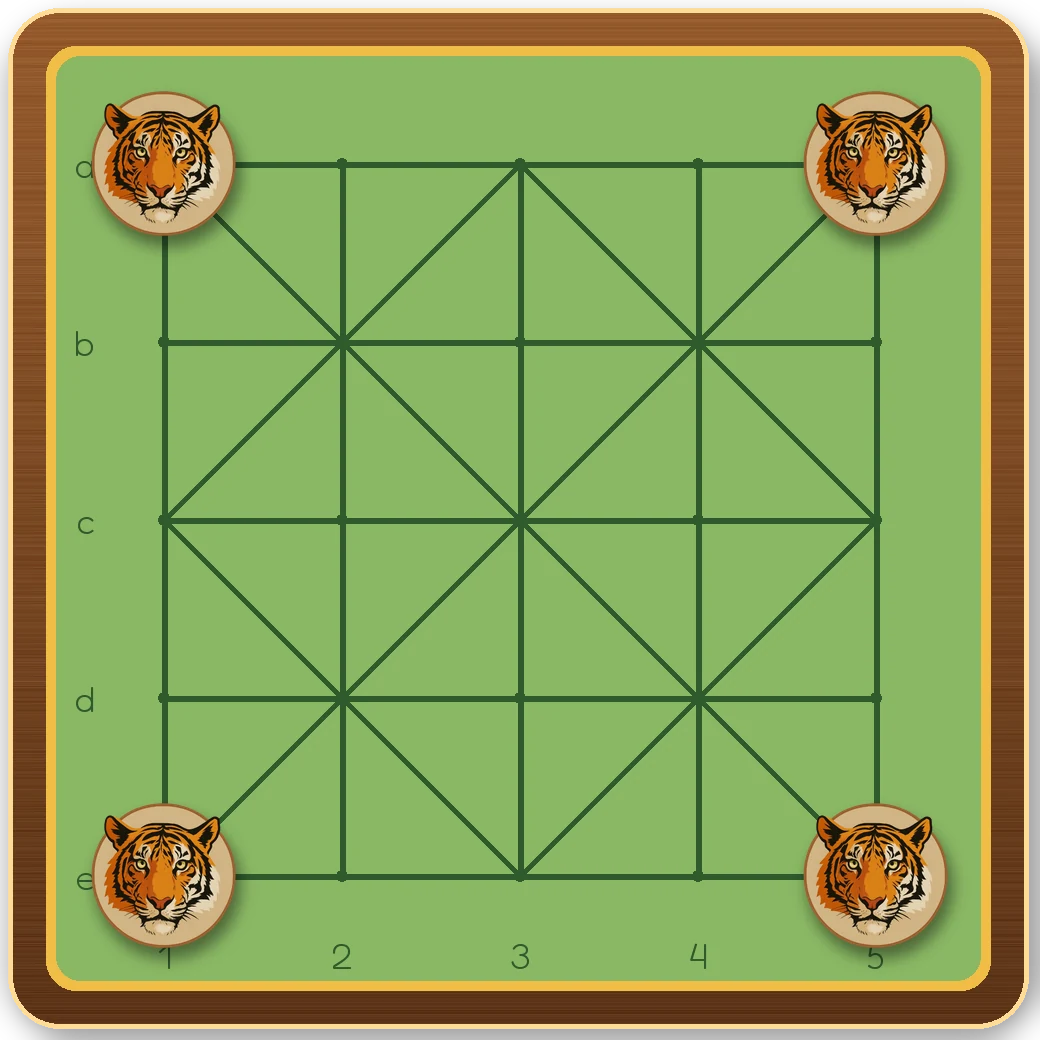
The board is a grid of 5 lines by 5 lines. You do not play in the squares. You play on the points where the lines meet. That gives 25 points.
Some points also have diagonal lines. They sit on every second point, in a checkerboard pattern, so 13 of the 25 points have them. A piece can only move along a line. A point with diagonals gives a piece more ways to move.
In this guide, the rows are a to e from top to bottom. The columns are 1 to 5 from left to right. The top left corner is a1. The bottom right corner is e5. The Baghchal Online app uses the same names.
How the game starts
The four tigers start on the four corners. No goats are on the board. The 20 goats wait beside it.
The goat player moves first.
Phase 1: placing the goats
In the first part of the game, goats are placed on the board. On each turn, the goat player puts one goat on any empty point. The goats cannot move yet.
Then the tiger player moves one tiger. A tiger can step to an empty point next to it along a line. Or it can jump over a goat to capture it. The tiger player must move on every turn.
Phase 2: moving the goats
Once all 20 goats are on the board, the goats must move too. On each turn, the goat player moves one goat along a line to an empty point next to it. Goats cannot jump.
A captured goat leaves the board for good. It does not come back.
How a tiger captures a goat
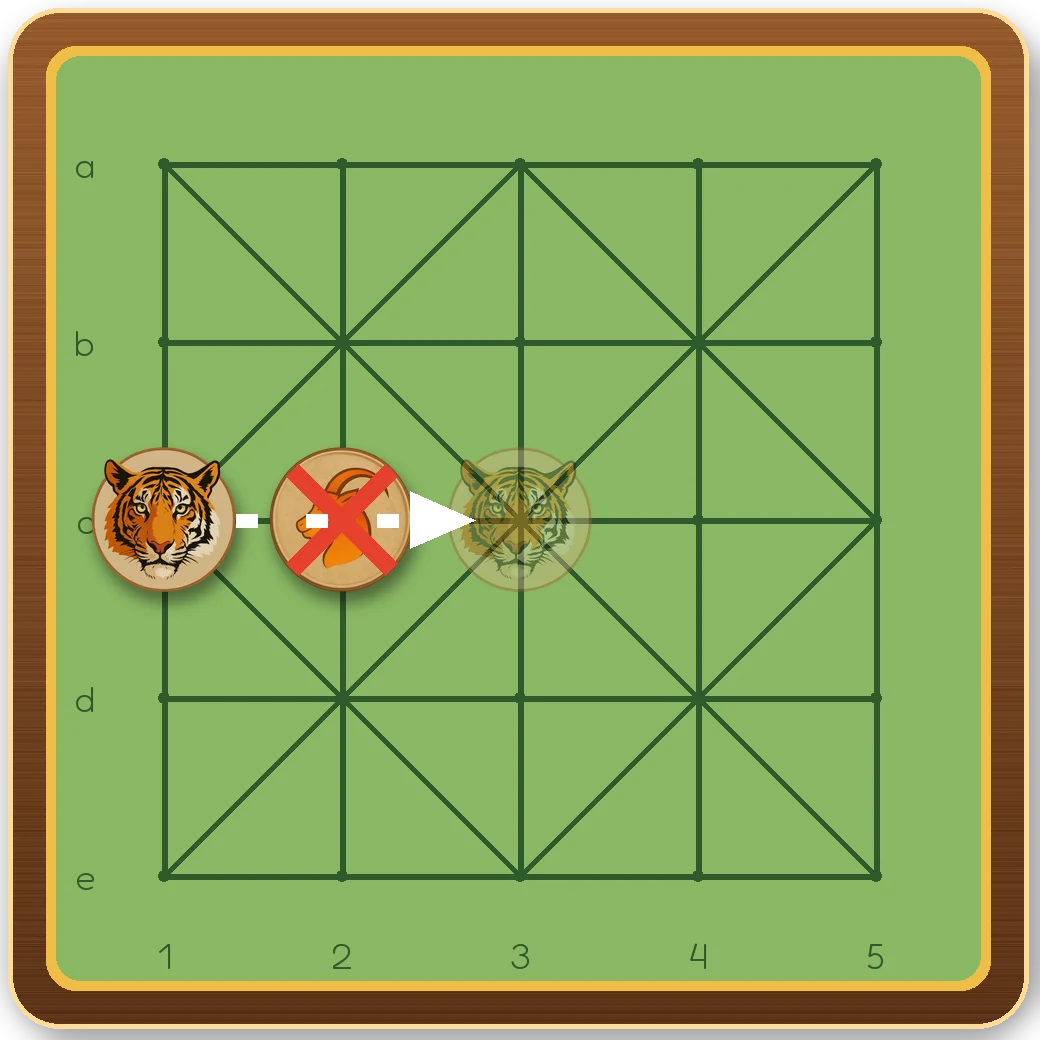
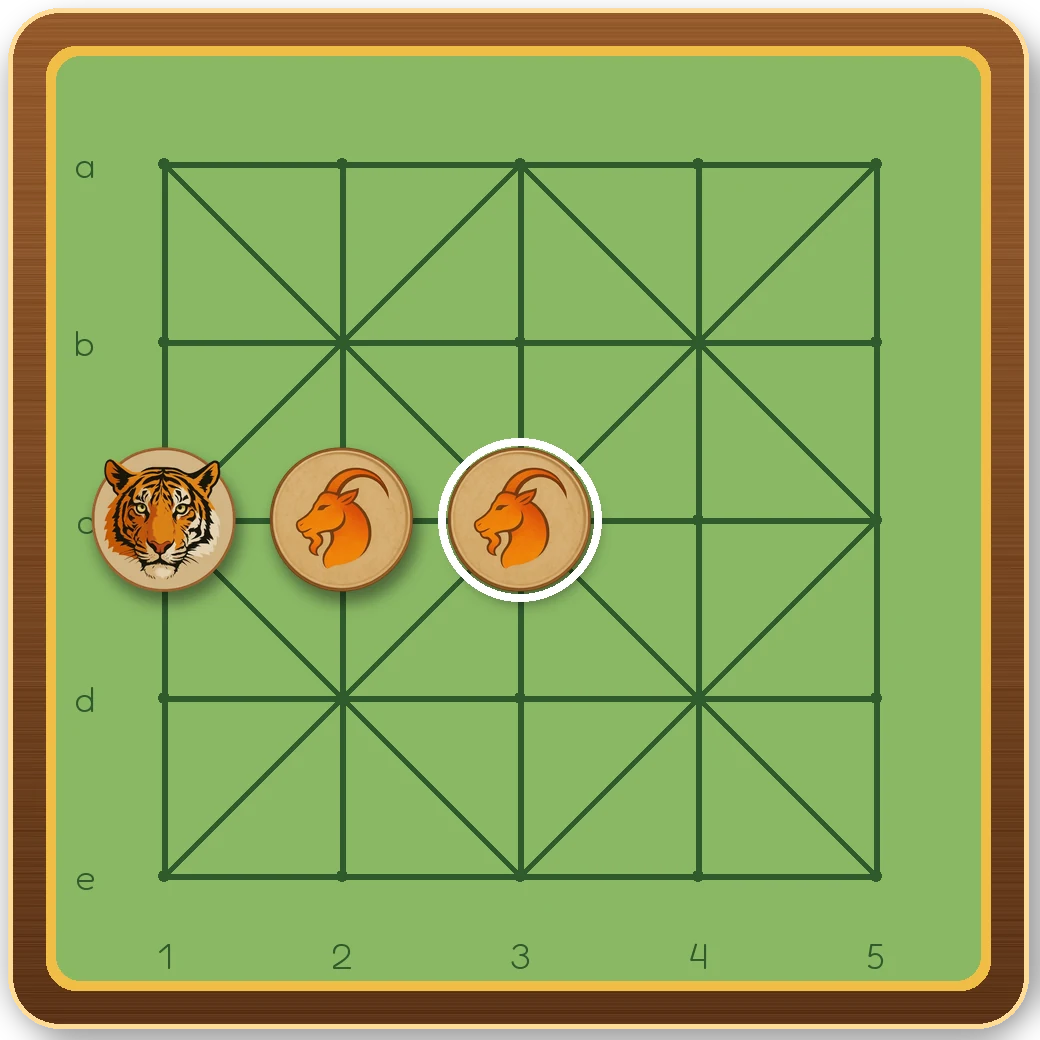
A tiger captures by jumping. The goat must be next to the tiger, on a line. The point right behind the goat, on the same line, must be empty. The tiger jumps over the goat and lands on that point. The goat is removed.
- A tiger can capture at any time, even in phase 1.
- A tiger captures one goat per turn.
- A tiger cannot jump over another tiger, or over two pieces in a row.
- A jump must follow a line. A diagonal jump only works on a diagonal line.
- In the usual rules, a capture is optional. The tiger does not have to jump. Some rule sets differ, so agree on this before you play.
How to win
The tigers win when they have captured 5 goats.
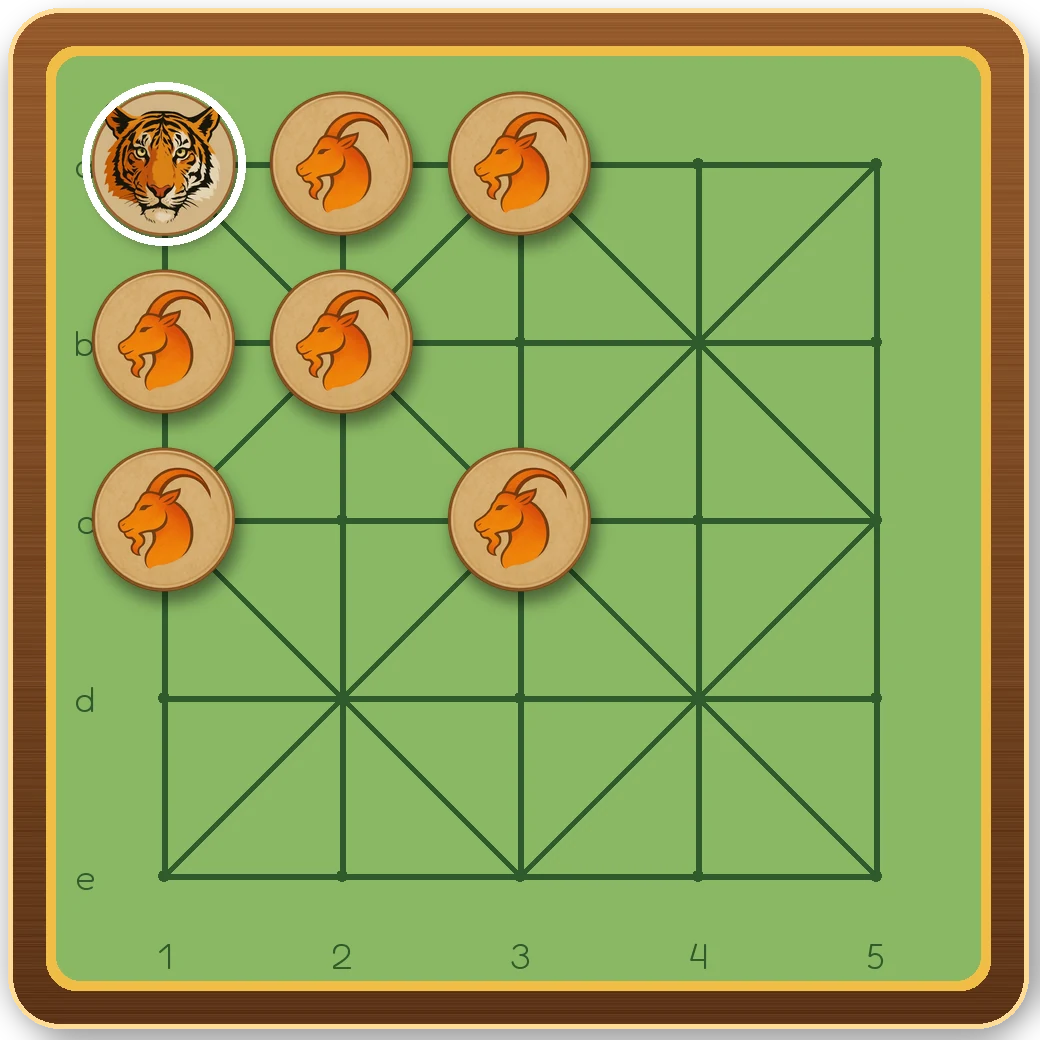
The goats win when they block every tiger. No tiger may be able to step or jump. To block a tiger, the goats must fill every point next to it. They must also fill the point behind each of those goats, so the tiger cannot jump.
Games can go in circles. To stop this, some rule sets say that once all goats are placed, no move may bring back a position that has already happened. Ask which rule your group uses.
Tips for goats
Every goat counts. You can lose four goats and still win. The fifth loss ends the game.
- Use the edges and corners. A goat in a corner can never be captured, because there is no point behind it. A goat on an edge can only be jumped along that edge. The tigers start in the corners, but when a tiger leaves, that corner is a safe home for a goat.
- Put a goat behind a goat. A goat is safe when the point behind it is full. Place goats in pairs and short chains, as in the blocked capture above.
- Do not leave a goat alone in the open. A goat with empty points all around it can be jumped from many sides.
- Take your time in phase 1. You have to place all 20 goats anyway. Before each placement, look at the empty point behind your new goat, on every line.
- Think before you move in phase 2. Moving a goat can open the point behind another goat. Ask what hole your move leaves. Then push the tigers toward the edges and corners, where they are easy to block.
For a deeper look, read our opening guide for goats.
Tips for tigers
You only need five captures. But goats will not give them away. Your strength is that you can move.
- Stay out of the corners. A tiger in a corner has only three neighbors, so it is easy to block. The picture above shows it. Move toward the center early.
- Keep your tigers apart. Four tigers in different parts of the board are harder to trap than four tigers side by side.
- Make two threats at once. If two goats can be captured, the goat player can only protect one.
- Be patient. In phase 1 the goat player must place a goat on every turn, and each new goat can leave a gap. Wait for a mistake. Do not chase a goat if the chase leads you into a trap.
- Count. After each capture, count how many captures you still need and how many goats are left to place. Goats get easier to catch once they have to move.
We explain these ideas with pictures in our tiger strategy guide.
How a game usually goes
The opening. The goat player places the first few goats. The tigers leave the corners and move toward the center, where they have the most room.
The middle. The goats keep coming. Each new goat can close a gap or open one. The tigers look for goats that have nothing behind them. Many captures happen at this stage.
The end. When all goats are placed, the game changes. The goats must move now, and every move can leave a hole. The tigers wait for those holes. The goats try to move forward together and push the tigers back.
Ways to practice
- Play both sides. You learn the most when you see the game from the tiger side and the goat side.
- Draw the board on paper. Use four coins for tigers and twenty small stones for goats. Our guide to making a Baghchal board shows how.
- Play without a timer at first. Look at every empty point behind a goat before you move.
- After a game, find the move where you lost your first goat. Ask what you could have done one turn earlier.
Where Baghchal comes from
The name. In Nepali, bagh means tiger and chal means move. Baghchal means roughly "moving the tiger". In the Newar language, the game is called dhun kasa, which means "tiger game".
An old game with no written record. People think Baghchal comes from Nepal. But nobody wrote down its early history. A 2021 report in The Kathmandu Post says the game was passed from person to person by watching and talking.
In that report, Tri Ratna Manandhar, a retired history professor, said he saw many people play it in rural places like Gorkha, Lamjung and Nuwakot about 50 years ago. He guessed that it may come from Gorkha, but he said he has no written proof.
Some players think herders made the game. Sagar Maharjan, who won a national Baghchal contest in 2019, said it was probably a way to pass the time while taking animals out to graze. In those days, tigers hunting weak goats was real life.
Played on the ground. You do not need a fancy board. Many players draw the lines on the ground or on a stone floor and use pebbles as pieces. The Kathmandu Post met older players doing this in rest houses called paatis in the Kathmandu Valley.
Fewer players, then new interest. As Nepal's cities grew, fewer young people played. A professor at Kathmandu University told the Post that the game lost ground after the 1990s. He also said that schools, clubs and groups have started to hold contests in recent years. Read more in our post on the history of Baghchal.
Similar games. Baghchal looks a lot like Aadu Puli Attam, a tiger and goat game from India. The board is different, but the idea is the same.
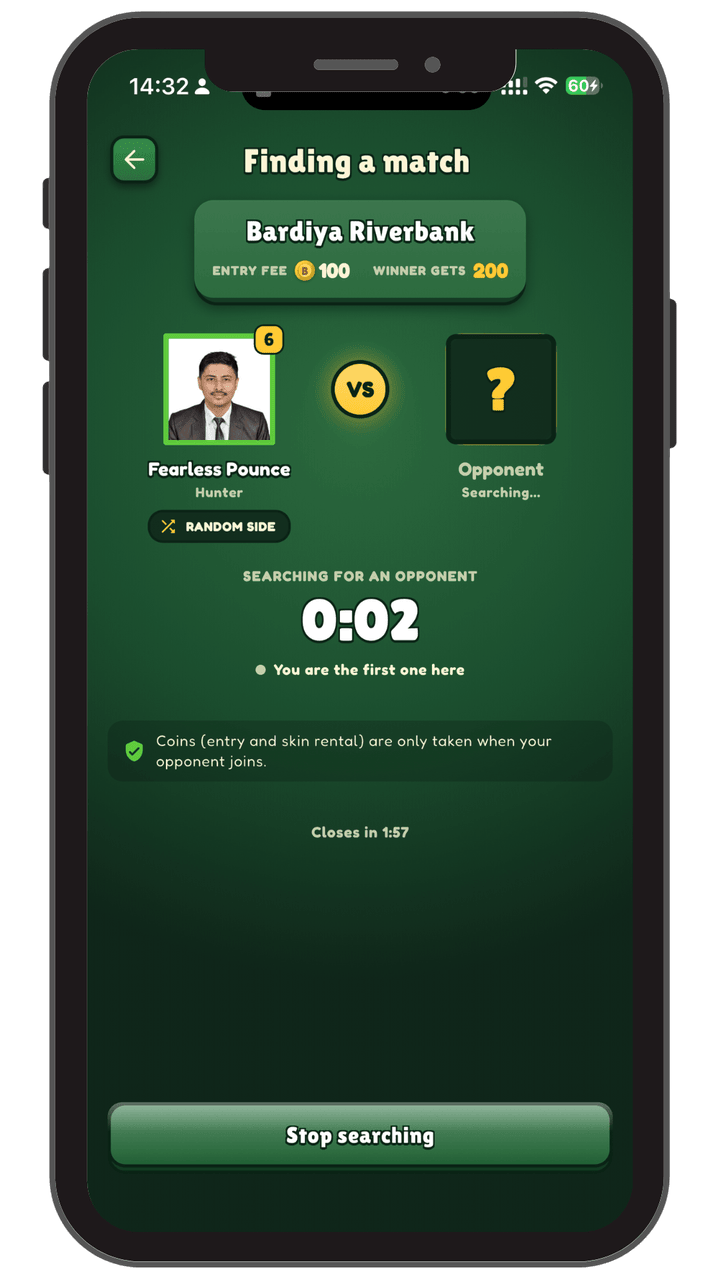
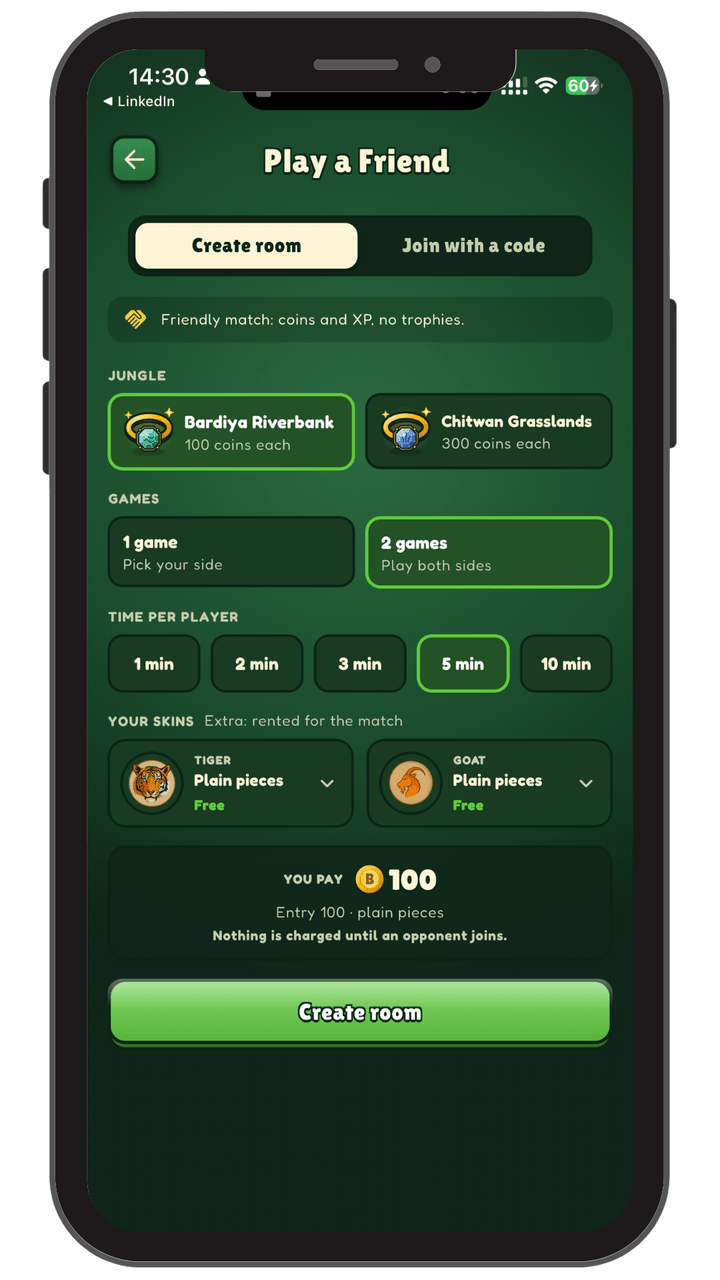
Play Baghchal on your phone
Baghchal Online lets you practice or play for fun in four ways:
- Play real people online.
- Make a private room and send the code to a friend.
- Play 34 creatures that get harder as you win.
- Use Pass and Play to share one phone with a friend. No internet needed.
The app is on Google Play for Android. An iPhone version is coming soon.

Questions and answers
Who moves first in Baghchal?
The goat player moves first. They place the first goat on the board.
How many goats must the tigers capture to win?
Five. When the tigers have captured five goats, they win.
Can goats move before all 20 are placed?
No. Until all 20 goats are on the board, goats can only be placed. After that, they move one step at a time.
Does a tiger have to capture when it can?
In the usual rules, no. A capture is optional. Some groups play with a must-capture rule, so agree on this before you start.
Can goats capture tigers?
No. Goats never capture. They win by blocking every tiger so that none can step or jump.
What does Baghchal mean?
In Nepali, bagh means tiger and chal means move. Baghchal means roughly "moving the tiger".