

Baghchal is one of the best known traditional games of Nepal. Yet nobody knows who made it, or when. This post collects what the best sources say. It also says clearly what is not known.
If you only want the rules, read the complete guide.
The name
In Nepali, bagh means tiger and chal means move. Baghchal means roughly "moving the tiger". In the Newar language, the game is called dhun kasa, which means "tiger game".
Outside Nepal, it is often called Tigers and Goats.
A game with no written history
Many websites say Baghchal is more than a thousand years old. We did not find proof for that. The Kathmandu Post wrote in 2021 that the game is thought to be native to Nepal. It also said that, because the game has no written history, its exact origin is hard to trace.
According to that report, the game was passed from one generation to the next by watching and by word of mouth.
Tri Ratna Manandhar, a retired professor of history, told the Post that the game is not mentioned in the history texts he has read. He saw many people play it in rural areas like Gorkha, Lamjung and Nuwakot about 50 years ago. People from Gorkha seemed especially good at it. So he guessed that it may come from Gorkha. He added that he has no written proof.
Why herders may have made it
The theme of the game is a tiger hunting weak goats. Manandhar said the farming life of Nepal must have shaped the game, because it was popular in rural places.
Sagar Maharjan, a winner of a national Baghchal contest in 2019, went further. He said the game was probably a way to pass the time when people took their animals out to graze. In those days, he said, tigers hunting weak goats was real, so the game was both fun and a lesson.
This is a guess by two people, not a proven fact. But it fits the game well.
A game played on the ground
You do not need a fancy board to play. In its report, the Kathmandu Post said that most people who play Baghchal do not use a board. They draw the board on a smooth surface and use stones as pieces. The Post found older players doing this in rest houses called paatis in the Kathmandu Valley.
Wikipedia's page on traditional games of Nepal also says Baghchal can be played on chalk-drawn boards with pebbles.
Boards are sold too. The Post described stalls in the three Durbar Squares of the Kathmandu Valley that sell metal or wooden boards. One stall owner told the Post that only foreigners buy them. The Horniman Museum in London keeps a set with a brass board, four brass tigers and 20 brass goats, and describes it as the national game of Nepal.
Learn how to make your own in our guide to making a Baghchal board.
A game for families and neighbors
In a 2020 essay in The Gorkha Times, writer Arjun Poudel argued that Baghchal can be called a classic. He wrote that, for the millions of Nepalis who play it, its main job is to bring families and neighbors together at times of rest. He also wrote that he first learned to draw the board during a family ritual like that. And he noted that, unlike card games or dice games, Baghchal is a game of reason, not chance.
Why fewer people played
According to the 2021 Post report:
- Manandhar said he no longer saw people play it near his home. His guess was that simple games like this one are being replaced by chess and phone games.
- Sagar Maharjan said that his friends who play are all in their late 50s to early 60s, and that his grandson prefers his smartphone.
- Nirmala Mani Adhikari, an associate professor at Kathmandu University, said that fast city growth after the 1990s was a bad time for the game. The village life that the game came from lost its place. For two decades the game lost popularity.
The revival
The same report described a revival starting. Adhikari said that schools, clubs and groups have begun to hold Baghchal contests. The pandemic stopped them for a while. He hoped they would pick up again.
Maharjan won a National Baghchal Competition in 2019, held by the Pragativaadi Youth Society Nepal. Manandhar said the game should be recognized by local governments, so that awareness programs can follow.
Other people have tried to bring the game to new fans. In 2022 a board game company ran a Kickstarter campaign to raise awareness of the game.
Phones and websites
The Post's report said that online versions could be another way to keep the game alive. It also quoted Maharjan, who said that the feeling of a real game on a real board, with tension in the air, cannot be matched online. He thought the main focus should stay on the physical game.
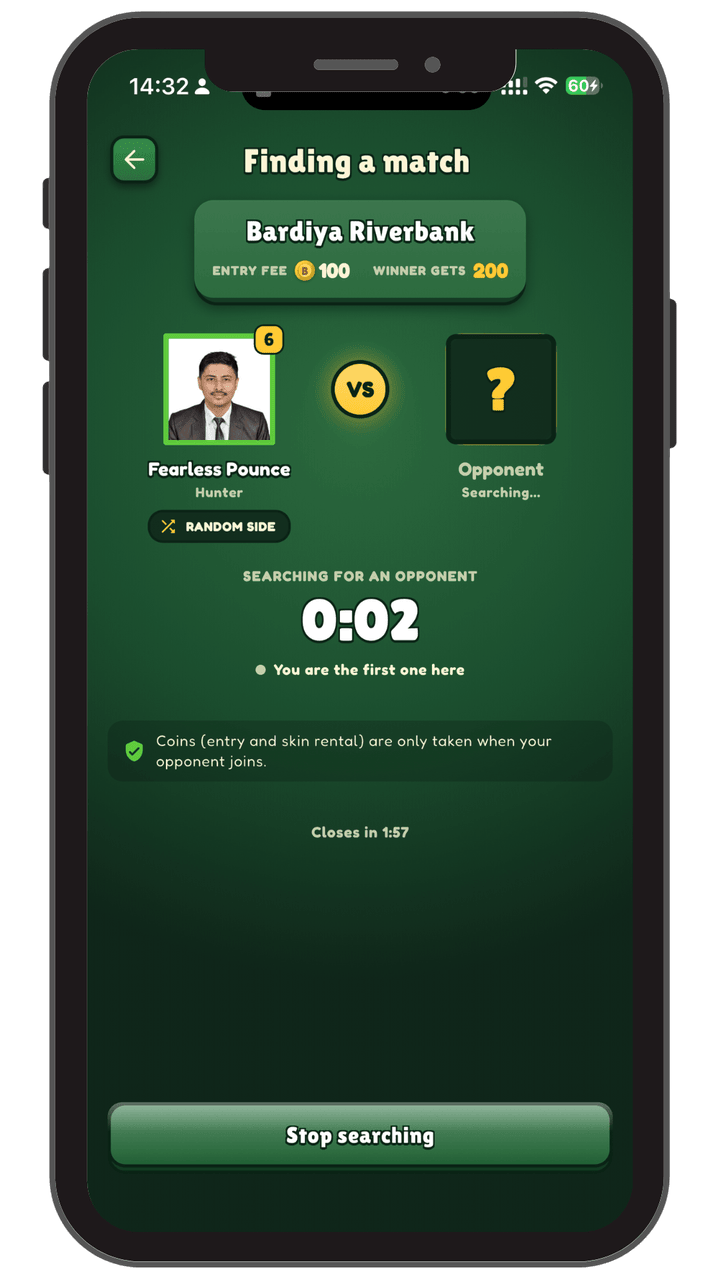
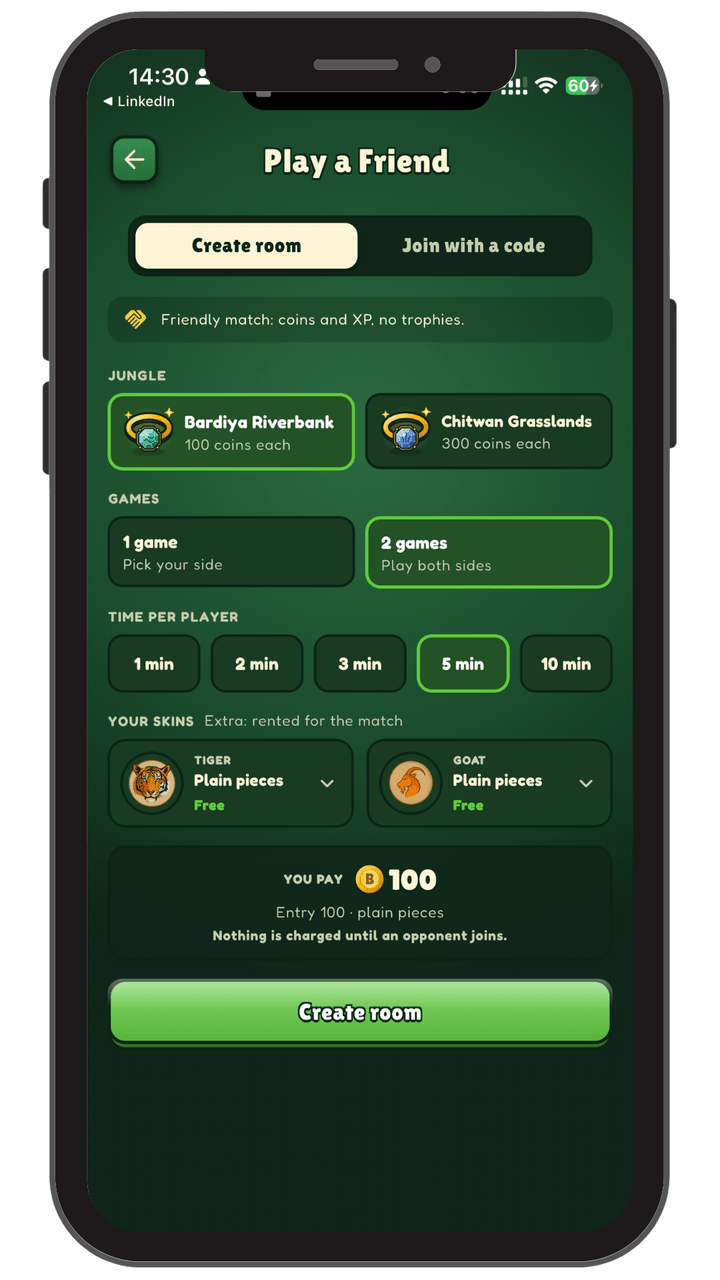
We agree that both can help. A phone game lets you find a player at any hour, and a board lets you play with whoever sits next to you. Our own app, Baghchal Online, tries to do the first: it offers online matches, private rooms, and Pass and Play on one phone.
What we can say for sure
- The game has been played in Nepal for a long time.
- It has no written history, so its exact origin is not known.
- It was passed on by word of mouth and by watching.
- It is often played on boards drawn on the ground.
- Fewer people played in recent decades, and groups are now trying to bring it back.
Play Baghchal on your phone
Baghchal Online lets you practice or play for fun in four ways:
- Play real people online.
- Make a private room and send the code to a friend.
- Play 34 creatures that get harder as you win.
- Use Pass and Play to share one phone with a friend. No internet needed.
The app is on Google Play for Android. An iPhone version is coming soon.

Questions and answers
Where does Baghchal come from?
It is thought to come from Nepal. Its exact origin is not known, because it has no written history.
How old is Baghchal?
Nobody knows. Some websites say more than a thousand years, but we found no proof for this.
Is Baghchal the national game of Nepal?
Some museums and sellers call it that, for example the Horniman Museum. We did not find an official source for this.
Is Baghchal dying out?
A 2021 report said it was in decline but that a revival had started, with contests held by schools, clubs and groups.
What does Baghchal mean?
Bagh means tiger and chal means move. It means roughly "moving the tiger".
Sources
- "Bagh Chal: A native board game on the brink of extinction", Shranup Tandukar, The Kathmandu Post, September 9, 2021.
- Bagh-chal, Wikipedia.
- Traditional games of Nepal, Wikipedia.
- "Bagh-chal: A Nepali Classic?", Arjun Poudel, The Gorkha Times, 2020.
- Bagh Chal Game, brass set, Horniman Museum.
- Bagh Chal Kickstarter by Lemery Games, as reported by Tabletopping.