
Yes, Baghchal is a solved game. Two researchers used computers to find out what happens when both sides play perfectly. The answer: the game is a draw.
This post explains what "solved" means, how it was done, and what it means for you. We use the researchers' own papers and say clearly what they found.
If you do not know the rules yet, read the complete guide.
What does "solved" mean?
A game is solved when we know the result of perfect play from the start. There are three possible results: the first player wins, the second player wins, or it is a draw.
Solving a game does not mean the game is boring. A solved game can still be hard for people. Nobody plays perfectly.
Who solved it?
Two researchers, Lim Yew Jin and Jürg Nievergelt, studied Baghchal. They wrote two papers about it.
- In 2004, they published "Computing Tigers and Goats" in the ICGA Journal. This was an early report on an incomplete computer analysis. They found that the tigers can force the capture of up to three goats. They also found evidence that the goats can always get at least a draw.
- In 2009, they published "Tigers and Goats is a draw" in the book Games of No Chance 3. The title gives the result.
Later papers by other writers repeat this: when both sides play optimally, Baghchal ends in a draw.
Why was it hard?
The game looks small. But the number of possible games is huge. A 2016 paper that cites the study says the placement phase has a game tree of about 10 to the power of 41 games. The same paper says there are about 88 million possible positions in the movement phase.
The researchers used a computer to build up a large database of positions and their results, working backward from the end of the game. Early on, they could not search the full placement phase, so the work took many years.
What does a draw mean?
If both players play perfectly:
- The tigers cannot force a win.
- The goats cannot force a win.
- The game goes on, or it repeats, and nobody wins.
This is true under the rules the researchers used. Rule sets differ in small ways, such as how repeated positions are handled.
What does it mean for you?
Not much, in practice. No human plays perfectly. So both sides can win a real game.
- Goats should know that they have a safe path. If they stay careful, they cannot be forced to lose. Our opening guide shows the first safe steps.
- Tigers should know that they need the goat player to slip. The best way is to create threats that a tired player might miss. See our tiger strategy guide.
Do we agree with the research?
We are not the authors of the research. But we ran a small test of our own. In our opening analysis, a computer search shows that the goats have only four safe first moves, the middle points of the edges. This matches the idea in the research that the goats can avoid an early loss with the right first move. Our test is small, and the researchers' work is far larger.
A short timeline
| Year | What happened |
|---|---|
| 2004 | "Computing Tigers and Goats" is published. It reports an incomplete analysis. |
| 2009 | "Tigers and Goats is a draw" is published. The game is solved. |
Learn more
- The papers are listed below.
- For a friendly comparison with a game that is not solved, read Baghchal vs Chess.
Play Baghchal on your phone
Baghchal Online lets you practice or play for fun in four ways:
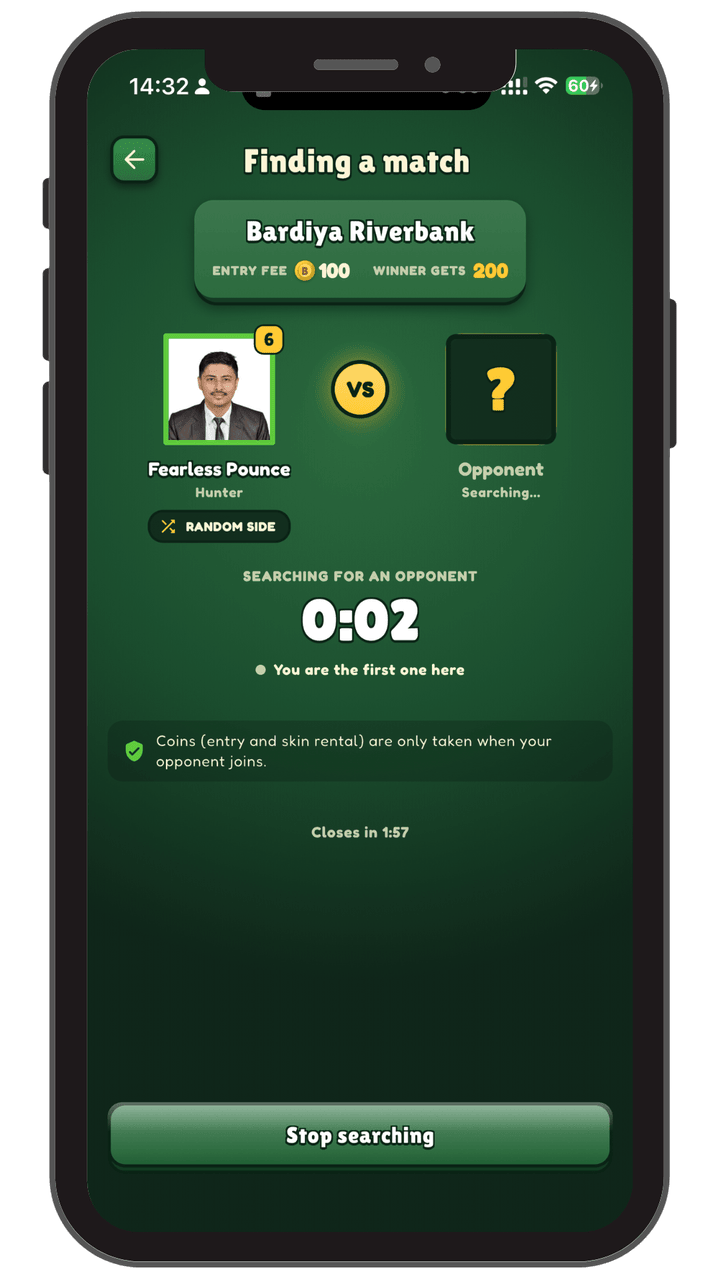
- Play real people online.
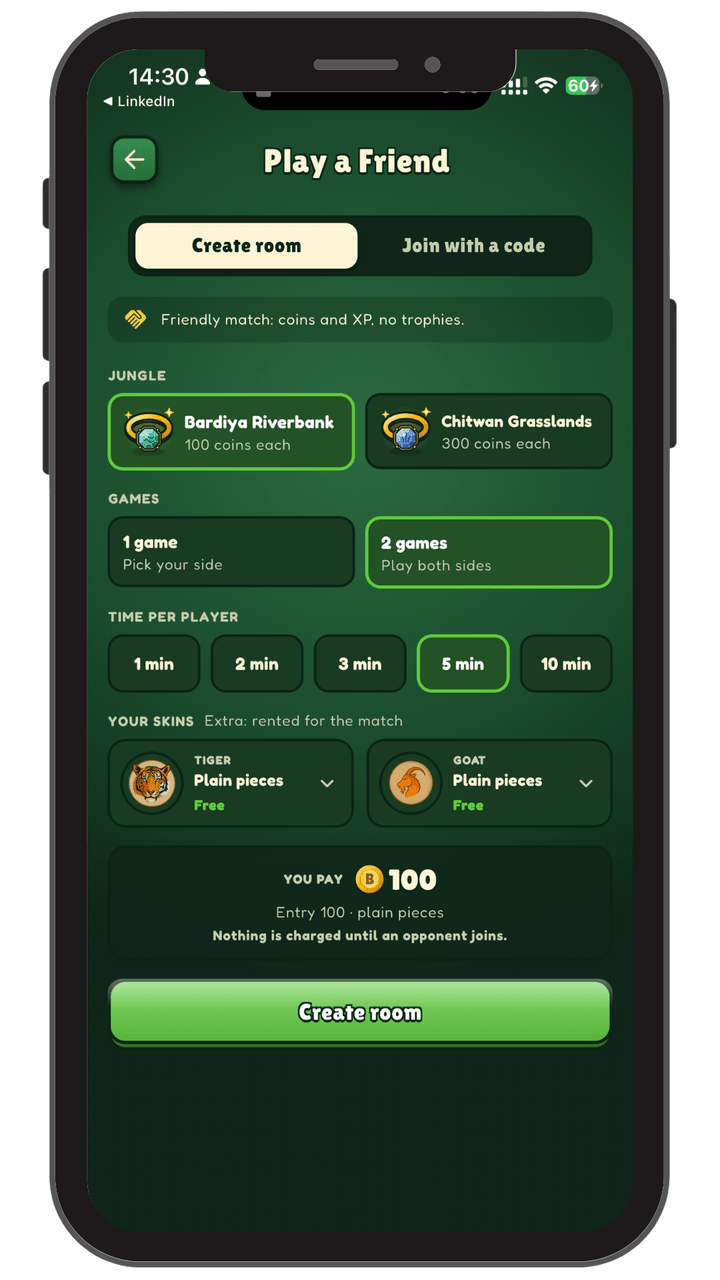
- Make a private room and send the code to a friend.
- Play 34 creatures that get harder as you win.
- Use Pass and Play to share one phone with a friend. No internet needed.
The app is on Google Play for Android. An iPhone version is coming soon.

Questions and answers
Is Baghchal solved?
Yes. A 2009 paper by Lim Yew Jin and Jürg Nievergelt showed that Baghchal is a draw with perfect play.
Who wins in Baghchal with perfect play?
Nobody. With perfect play, it is a draw.
Does that mean the goats or tigers have an advantage in real games?
In real games, mistakes decide most results. Either side can win.
Why did it take so long to solve?
The number of possible games is very large, especially in the placement phase.
Are all rule sets the same?
No. Small rules, like how repeated positions are handled, differ between groups.
Sources
- Lim Yew Jin and Jürg Nievergelt, "Computing Tigers and Goats", ICGA Journal 27(3), 131-141, 2004.
- Lim Yew Jin and Jürg Nievergelt, "Tigers and Goats is a draw", Games of No Chance 3, 163-176, Cambridge University Press, 2009.
- Sergio Gutiérrez Perera, "Play in Scientific and Mathematical Non-Formal Education. Bagh Chal, a Tigers-and-Goats Game", 2016.
- Agarwal and Iida, "Analyzing Thousand Years Old Game Tigers and Goats is Still Alive", 2018.