

Baghchal is a good game for a classroom or a family evening. The rules take five minutes to explain. The game needs no electricity, and it can be played on paper. It also gives children something to think about: where is the weak spot, and what happens next?
This post gives you a free 45 minute lesson plan, some questions to ask, and a fun activity where the students become the pieces.
Why use Baghchal in a lesson?
- It is easy to start. There are only two kinds of pieces and one kind of move.
- It needs little. Paper, a pencil and some coins are enough.
- It starts talk. There is a tiger side and a goat side, and each side needs a different plan.
- It connects to a culture. It is a traditional game of Nepal, so it fits lessons on culture and heritage.
- It can be played with no luck. The result depends on thinking, not dice.
Some teachers and researchers have used it in lessons already. A 2016 paper on science and math education described activities with Baghchal, including a role-playing game where 24 volunteers act as the pieces: 20 as goats and 4 as tigers.
Who is it for?
The plan below works well for children aged about 8 and older. For younger children, play with only the tigers and a few goats. For older students, add a discussion about strategy.
Free lesson plan (45 minutes)
Download the lesson plan (PDF)
Here is the plan in short.
| Time | What to do |
|---|---|
| 5 min | Show the board. Ask: "Which side do you think is stronger, the tigers or the goats?" |
| 5 min | Teach the rules. Use the rules guide and the pictures. |
| 20 min | Pairs play on paper boards. Halfway through, they swap sides. |
| 10 min | Class talk. Use the questions below. |
| 5 min | Wrap up. Each pair tells the class one thing they learned. |
What you need
- A printed board for each pair. Use our printable board.
- 4 tiger pieces and 20 goat pieces for each pair (coins, stones or paper circles).
Questions to ask
- Where is a goat safe? Where is it not?
- Why do tigers want to leave the corners?
- What does a good goat player do before placing a goat?
- Is it ever right to let a tiger capture a goat?
- If you play the other side, what do you do differently?
- How is this game like a team game?
The human board game
This is a fun activity for a bigger group. It needs 24 volunteers and a floor space.
- Draw a large 5 by 5 board with chalk on the floor, or lay out ropes. Each crossing is a point.
- Choose 4 children to be tigers and 20 to be goats. The rest are the two players, who call out the moves.
- The goat player says where each new goat should stand. The tiger player says where a tiger steps.
- The children move as told. When a goat is captured, that child steps out of the board.
The children see the board from the inside. This helps younger ones understand why a goat needs a goat behind it.
Skills students can practice
- Looking ahead and planning.
- Noticing patterns on a grid.
- Explaining a reason for a move.
- Taking turns and losing with grace.
For parents
You can use the same plan at home.
- Print the board and play a quick game after dinner.
- Let the child pick a side. Swap after one game.
- Ask: "What would you do next?" before you say what you would do.
- Try our Baghchal puzzles together.
Play Baghchal on your phone
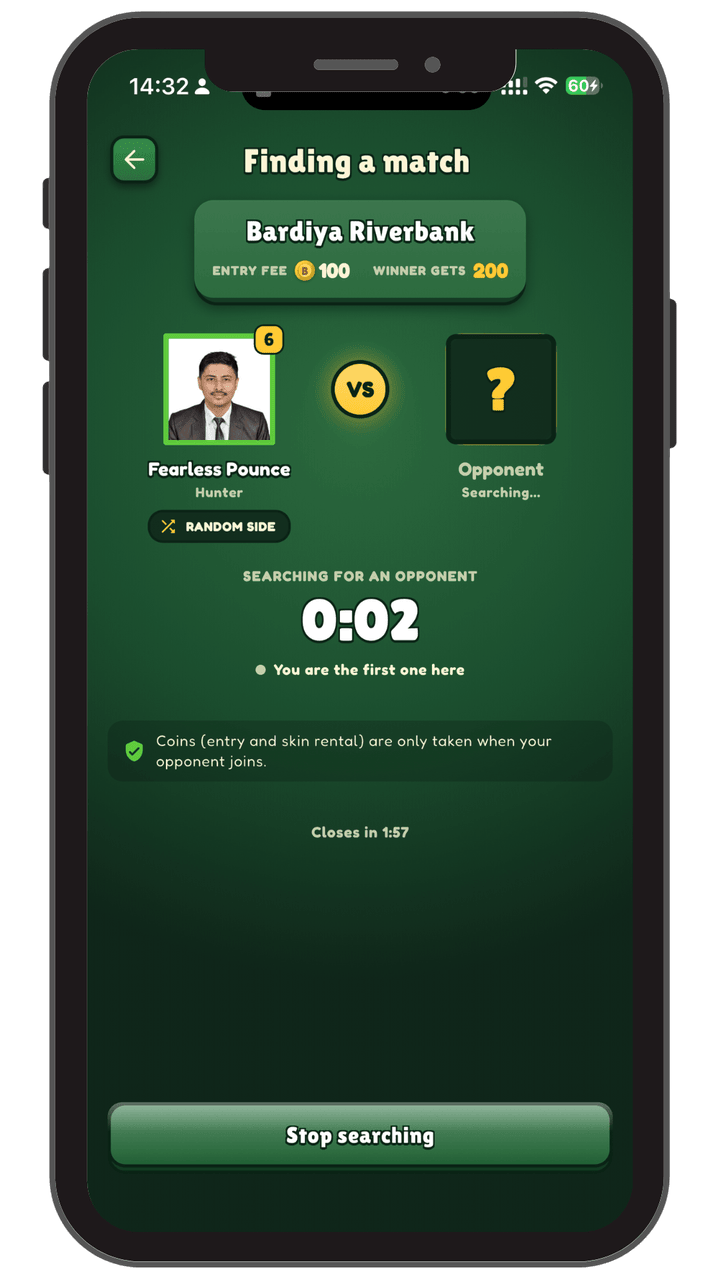
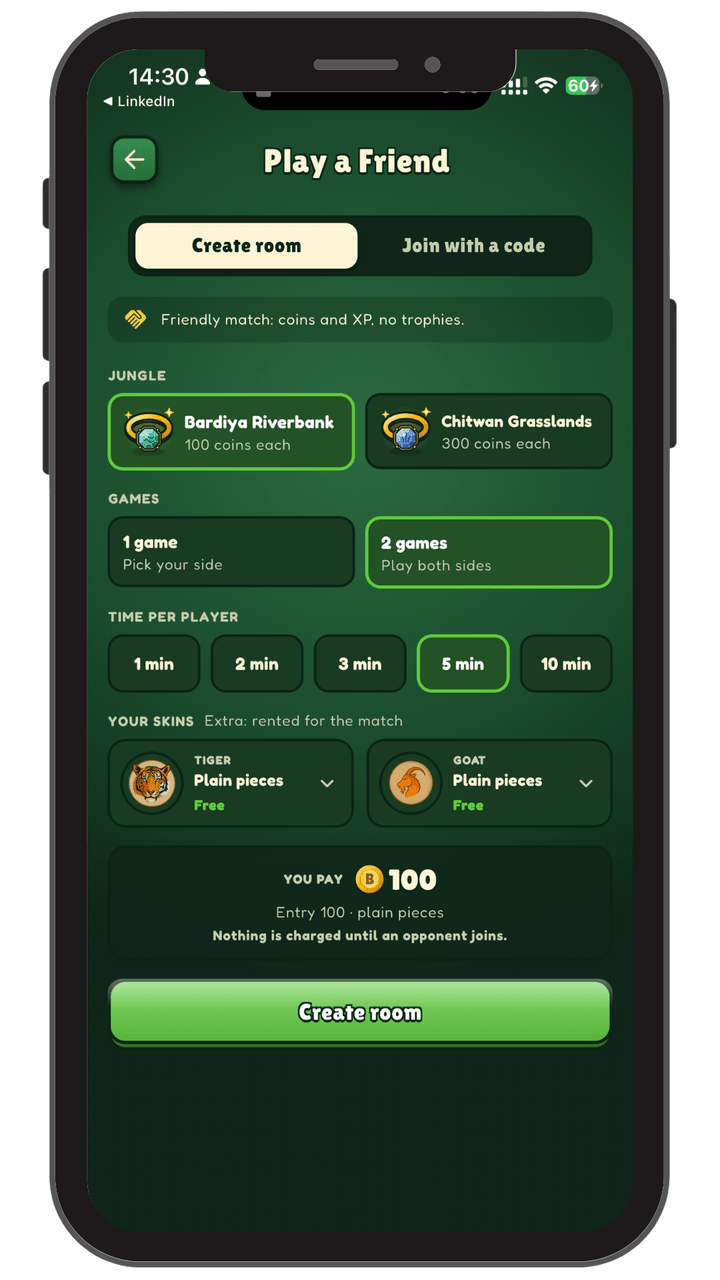
Baghchal Online lets you practice or play for fun in four ways:
- Play real people online.
- Make a private room and send the code to a friend.
- Play 34 creatures that get harder as you win.
- Use Pass and Play to share one phone with a friend. No internet needed.
The app is on Google Play for Android. An iPhone version is coming soon.

Questions and answers
What age is Baghchal good for?
Children about 8 and older can play the full game. Younger children can try it with fewer pieces.
How long does a game take?
A short game on paper takes about 10 to 20 minutes.
Do we need to buy anything?
No. A printed board and some coins or stones are enough.
Is there any luck in Baghchal?
No. The result depends only on the moves.
Can it be used in a culture lesson?
Yes. It is a traditional game of Nepal. See our post on [the history of Baghchal](../baghchal-history/).